
Tonto is based on UFO, the Unified Foundational Ontology. UFO provides domain-independent distinctions that help ontology modelers choose precise stereotypes and avoid ambiguous models.
Endurants and perdurants
| Concept | Meaning | Tonto examples |
|---|---|---|
| Endurant | Exists in time while remaining the same individual through change. | kind Person, relator Enrollment, quality Weight. |
| Perdurant | Unfolds in time and has temporal parts. | event EnrollmentCeremony, process CourseDelivery. |
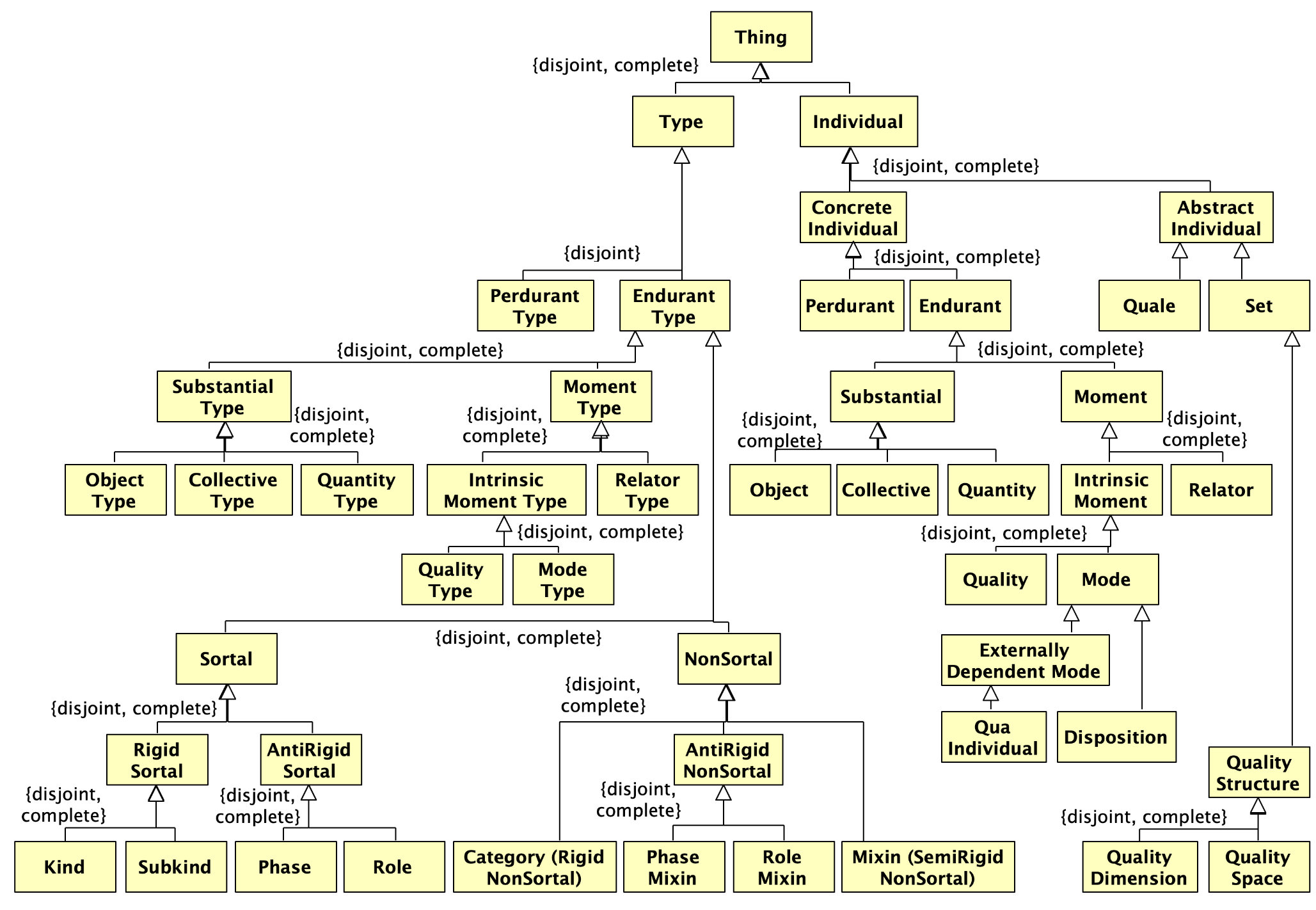
Sortality
Sortals provide or inherit identity principles.
kind,collective,quantity,quality,mode,relator,type, andpowertypeare ultimate sortal-like roots in Tonto syntax.subkind,phase,role, andhistoricalRoleinherit identity through specialization.
Non-sortals classify entities across identity principles:
categorymixinphaseMixinroleMixinhistoricalRoleMixin
Rigidity
Rigidity describes whether classification is essential.
| Category | Meaning | Examples |
|---|---|---|
| Rigid | Every instance must remain classified by the type. | kind Person, subkind Man, category PhysicalObject. |
| Anti-rigid | Instances may stop being classified by the type. | phase Child, role Student. |
| Semi-rigid | Essential for some instances, accidental for others. | mixin Insurable. |
Relators
Relators are central to many OntoUML models. A relator is the truth-maker for a material relation.
kind Person
kind Company

role Employee specializes Person
role Employer specializes Company

relator Employment {
  @mediation [1] -- [1] Employee
  @mediation [1] -- [1] Employer
}

@material relation Employee [0..*] -- worksFor -- [0..*] Employer
Use relators when the relation itself has unity, identity, or attributes.